
Imagine receiving a call from an unknown number late at night. You do not recognize it. You do not know if it is safe to answer. You have no way of finding out who is on the other end — or at least, that used to be the case.
In Pakistan today, millions of people face this exact situation every single day. Unknown callers. Suspicious messages. Numbers they cannot identify. And behind many of those numbers is a very real threat — scammers, fraudsters, and criminals who hide behind unverified SIM cards to target innocent citizens.
But 2026 is different. Today, you have the power to find out exactly who owns any mobile number in Pakistan. You can check SIM owner details online, for free, in seconds. You can find out how many SIMs are registered against a CNIC. You can protect yourself, your family, and your money from people who rely on anonymity to cause harm.
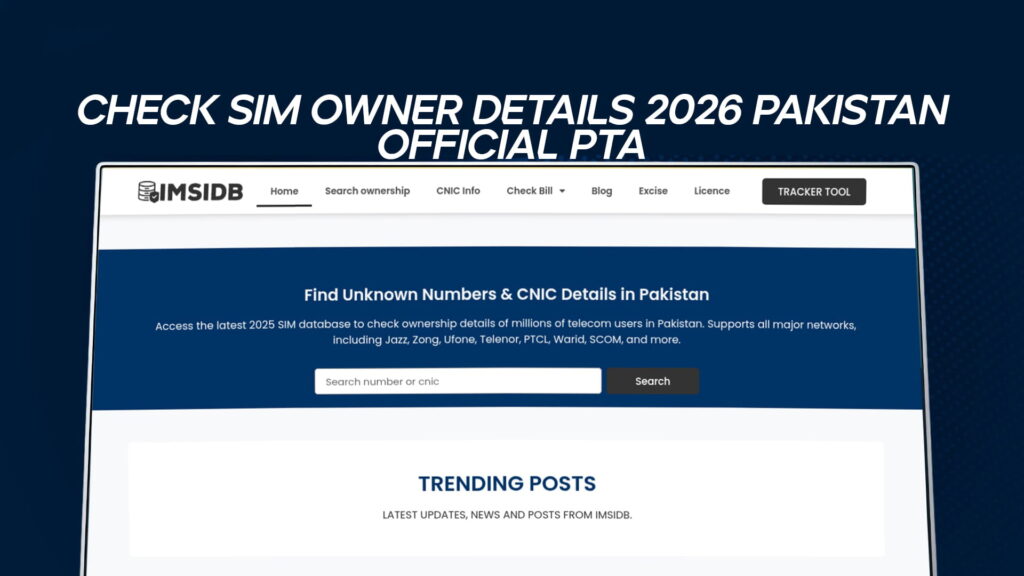
That power comes from IMSIDB — Pakistan’s trusted platform for finding unknown numbers and CNIC details using official PTA data. Whether you are dealing with a suspicious caller, verifying a contact, or checking your own identity records, IMSIDB gives you the answers you need quickly, accurately, and at absolutely no cost.
This article is your complete guide to checking SIM owner details in Pakistan in 2026. By the time you finish reading, you will know exactly how the system works, how to use IMSIDB, what your rights are, and how to protect yourself from the very real dangers of SIM fraud in Pakistan today.
What Is IMSIDB?
IMSIDB is Pakistan’s dedicated online platform for finding unknown numbers and accessing CNIC ownership details using official PTA data. It was built specifically to give Pakistani citizens direct, transparent access to SIM ownership information that was previously difficult or impossible to access for the average person.
The platform serves one core purpose — to help people find the truth about who owns a number or whose name a SIM is registered under. Whether you are trying to identify a stranger who called you, verify a business contact, check your own CNIC for unauthorized registrations, or investigate a suspicious number that messaged someone in your family, IMSIDB is the tool that makes it possible.
What makes IMSIDB stand out from other services is its use of official PTA data. The Pakistan Telecommunication Authority is the government body responsible for overseeing all SIM registrations in the country. IMSIDB accesses SIM and CNIC ownership information that is aligned with PTA’s official registration records, which means every result you get is based on verified, legitimate data — not guesswork, not unofficial sources, and not outdated information.
The platform is available to everyone. You do not need to create an account. You do not need to pay anything. You do not need any technical knowledge. If you can open a website and type a number, you can use IMSIDB.
Why SIM Owner Verification Matters More Than Ever in 2026
Pakistan’s mobile landscape has changed dramatically over the past few years. Today, your phone number is not just a way to make calls. It is connected to your bank account. It receives your financial OTPs. It is linked to your mobile wallet. It is part of your digital identity in almost every online service you use.
This makes your SIM card — and the ownership records tied to it — incredibly important. And it makes the problem of SIM fraud incredibly serious.
Here is why checking SIM owner details in 2026 is more critical than ever before.
Mobile Banking Is Everywhere
Services like JazzCash, Easypaisa, and mobile banking apps from almost every major bank in Pakistan all depend on your registered phone number for verification. If someone gains access to a SIM registered in your name, they potentially have access to every financial service linked to that number. A fraudulent SIM registration today can lead to a complete financial compromise tomorrow.
Online Scams Have Grown Dramatically
The number of phone-based scams in Pakistan has grown sharply in recent years. Fraudsters call people while pretending to be bank officials, prize hotlines, tax authorities, or even family members in trouble. These calls come from numbers that are often registered under stolen or fake identities, making them very difficult to trace — unless you use a platform like IMSIDB.
Digital Identity Theft Is a Real Threat
Your CNIC is the foundation of your identity in Pakistan. It is used for everything from opening a bank account to registering a business to buying property. If someone misuses your CNIC to register SIM cards in your name, they are effectively stealing a piece of your identity — and you may not even know it is happening.
SIM Registration Limits Affect Everyone
PTA restricts how many SIMs any single person can have registered against their CNIC. If someone fraudulently registers SIMs in your name, they use up your allowed quota. When you try to get a legitimate new SIM, you may be denied because the system thinks you are already at the limit. This kind of invisible damage can be deeply frustrating and takes time and effort to resolve.
All of these problems have one common solution — awareness and access to information. IMSIDB provides exactly that.
How IMSIDB Works: A Step-by-Step Guide
Using IMSIDB is designed to be as simple and straightforward as possible. You do not need to be tech-savvy, and you do not need to spend more than a minute to get the results you need. Here is exactly how it works.
Step 1: Open IMSIDB on Any Device
Visit IMSIDB from any browser on any device. The platform is fully optimized for mobile phones, tablets, and desktop computers. It loads quickly even on slower internet connections, which is important for users in areas without fast broadband access.
Step 2: Select Your Search Method
IMSIDB offers two primary ways to search. You can search by mobile number if you want to find out who owns a specific phone number. Or you can search by CNIC if you want to find out how many SIMs are registered against a particular identity card. Choose the method that fits what you need to know.
Step 3: Enter the Details
For a mobile number search, type the complete 11-digit number including the network code. For a CNIC search, enter the full 13-digit identity number. Double-check that you have entered the number correctly before proceeding, as even one wrong digit will return incorrect results.
Step 4: Run the Search
Click the search or check button. IMSIDB will immediately process your request and pull the relevant data from its official PTA-aligned database.
Step 5: Read Your Results
In just a few seconds, your results will appear on screen. For a mobile number search, you will see ownership information including the network operator and registration details. For a CNIC search, you will see a full list of all SIM numbers currently registered against that identity card.
Step 6: Take Whatever Action Is Needed
Use the information you have found to make informed decisions. If everything looks normal, you have peace of mind. If something looks wrong, you now have the information you need to take action.
That is all there is to it. The entire process is free, fast, and available to every Pakistani citizen at any time of day or night.
Finding Unknown Numbers in Pakistan with IMSIDB
One of the most popular and widely used features of IMSIDB is its ability to help you identify unknown numbers. This feature is used by millions of Pakistanis every month for a huge variety of reasons.
When an unknown number calls or messages you, your first instinct might be to ignore it. But sometimes that is not the right answer. It could be an important call from a number you do not have saved. It could be a scammer. It could be someone trying to reach you for a legitimate reason. Without knowing who owns the number, it is impossible to make an informed decision.
IMSIDB solves this problem instantly. By entering the unknown number into the search field, you can find out which network it is registered on and access the ownership information associated with it. This takes less than a minute and costs nothing.
Here are some of the most common situations where the unknown number finder feature proves invaluable.
Missed Calls from Unknown Numbers
You come back to your phone and see a missed call from a number you do not recognize. Before calling back, check it on IMSIDB. If the number appears suspicious or unverifiable, you have saved yourself from potentially engaging with a scammer.
Messages Asking for Money or Personal Information
If you receive a text message from an unknown number asking you to send money, click a link, or share your banking details, do not respond until you have checked who owns that number. IMSIDB gives you the background information that helps you decide whether to engage or block immediately.
Calls Claiming to Be from Official Bodies
Scammers in Pakistan frequently impersonate officials from organizations like FBR, NADRA, PTA itself, or major banks. They create a sense of urgency and pressure victims into sharing sensitive information. A quick check on IMSIDB can reveal that the number calling you is not actually registered to any official organization, exposing the scam before any damage is done.
Checking Who Contacted Your Child
Parents regularly use the unknown number search on IMSIDB to check the identity of numbers that have been contacting their children. This is a responsible parenting tool that helps keep young people safe from strangers with bad intentions.
Verifying a Contact Before a Meeting
Whether it is for a job interview, a property viewing, an online purchase pickup, or any other arrangement with someone you only know through a phone number, checking that number on IMSIDB before the meeting adds an important layer of security.
CNIC Details Lookup: Know What Is Registered in Your Name
The CNIC details lookup feature of IMSIDB is arguably its most important tool from a personal security standpoint. This feature allows any Pakistani citizen to enter a CNIC number and instantly see every mobile SIM that is currently registered against it across all networks.
This is not just useful — it is essential. Here is why.
Pakistan has hundreds of millions of active SIM cards. The biometric registration system ensures that every SIM is tied to a real identity. But the system is not perfect, and fraud happens. Criminals obtain CNIC copies through theft, data breaches, unauthorized photography, and other methods, then use those copies to register SIMs in other people’s names.
The victim of this kind of fraud often has no idea it is happening. There is no notification sent to you when a new SIM is registered in your name. You only find out when something goes wrong — when you are denied a new SIM because you are apparently at the limit, when you are contacted by police about a crime committed using your registered number, or when your bank account is accessed through OTPs sent to a SIM you never held.
Regular checks using the CNIC details lookup on IMSIDB prevent this situation. By checking your own CNIC once every few months, you can catch unauthorized registrations immediately and take action before any serious damage is done. It takes one minute and costs nothing.
Beyond personal security, the CNIC lookup feature is widely used for other legitimate purposes across Pakistan.
Employers use it to verify that job applicants are who they claim to be. Landlords use it to do basic background checks on potential tenants. Parents use it to monitor the digital footprint of their children’s identity documents. Business owners use it to verify the identities of partners and clients. And ordinary citizens use it simply because they have the right to know what is registered in their name.
All Networks Covered by IMSIDB
A platform that only covers one or two mobile networks would be of limited use in a country with five major operators. IMSIDB covers all of them, making it a truly comprehensive solution for SIM ownership verification across the entire country.
Jazz is the largest mobile network in Pakistan and was formerly known as Mobilink. Jazz serves tens of millions of subscribers and its numbers are identified by several different prefixes including 0300, 0301, 0302, 0303, 0304, 0305, and 0311. Whether you are checking a Jazz number from Karachi or Kashmir, IMSIDB can retrieve the ownership details.
Telenor Pakistan is one of the country’s most prominent networks, known especially for its data services and digital product offerings. Telenor numbers carry prefixes such as 0340, 0341, 0342, 0343, 0344, 0345, 0346, 0347, and 0348.
Zong, operated by China Mobile Pakistan, has grown to become one of the most popular networks for mobile data users and young professionals. Zong numbers commonly carry prefixes including 0310, 0311, 0312, 0313, 0314, and 0315.
Ufone, part of the PTCL family of companies, is one of the original telecom operators in Pakistan and maintains a significant subscriber base across the country. Ufone numbers are typically identified by prefixes such as 0330, 0331, 0332, 0333, and 0334.
SCOM, the Special Communications Organization, provides mobile services to the regions of Azad Kashmir and Gilgit-Baltistan. While it serves a smaller geographic area than the four national operators, it is fully supported by IMSIDB so that citizens in those regions can access the same SIM ownership verification services as everyone else in the country.
No matter which of these networks a number belongs to, IMSIDB can find the ownership details and present them to you in one simple search.
The Legal and Regulatory Framework Behind SIM Ownership in Pakistan
Understanding the legal foundation behind SIM ownership verification helps you understand why the information on IMSIDB is trustworthy and why using it is completely within your rights as a Pakistani citizen.
The Pakistan Telecommunication Authority operates under the Pakistan Telecommunication Re-organization Act and has authority over all aspects of the telecom sector including SIM registration, operator licensing, and consumer protection. PTA has established a comprehensive biometric SIM registration system that requires every new SIM to be activated with a fingerprint scan matched against NADRA’s national identity database.
This system creates a clear and verifiable chain of identity for every SIM card in Pakistan. Every active SIM is supposed to be traceable to a real, verified person. The IMSI number — International Mobile Subscriber Identity — is the unique technical identifier that sits at the core of this traceability system. It is what connects a mobile number on a network to the identity of its registered owner.
PTA also regulates how many SIMs a single person can hold. Currently, Pakistani nationals are generally permitted to have up to five SIMs registered against their CNIC across all networks, though this figure is subject to revision by PTA. Foreign nationals face different and more restrictive limits.
Citizens have the right to know what is registered in their name. This is not just a matter of personal preference — it is a matter of legal accountability. If a SIM is registered under your CNIC, you may bear some legal responsibility for how it is used. That makes it not just your right but your responsibility to know what SIMs are associated with your identity.
IMSIDB supports this right and responsibility by providing a free, accessible, and accurate tool for checking SIM ownership details. The platform’s use of official PTA data ensures that what you see reflects the actual regulatory records, not unofficial or unreliable sources.
Key Features That Make IMSIDB the Right Choice
There are multiple ways Pakistanis try to find SIM owner details, but IMSIDB offers a combination of features that makes it the most reliable and accessible option available. Here is what sets it apart.
Official PTA Data: The information on IMSIDB comes from official PTA-aligned sources. This is the most important feature of all because it means you can trust what you find. Results are not based on scraped data, unofficial databases, or guesswork. They reflect the actual registered ownership as recognized by Pakistan’s telecom regulator.
Unknown Number Finder: The dedicated unknown number search feature allows you to identify the owner of any mobile number in Pakistan across all five major networks. This is one of the most widely used features and provides results within seconds.
CNIC Details Lookup: The ability to enter a CNIC and see all associated SIMs is a powerful personal security tool that every Pakistani should use regularly. It is fast, accurate, and completely free.
Free to Use Always: There are no charges of any kind. No subscription, no per-search fee, no premium tier with better features. Every user gets full access to every feature at no cost every single time they visit.
No Account Required: You do not need to register, create a profile, or provide any personal information to use IMSIDB. Just open the platform and start searching. This also means your own privacy is fully protected.
Works on All Devices: From the most basic Android smartphones to the latest iPhones and everything in between, IMSIDB works on every device in every modern browser without requiring any downloads or installations.
Fast and Accurate Results: Results are delivered in seconds, and they are based on current data rather than outdated records. This real-time accuracy is critical when you need information quickly to protect yourself from an active threat.
Simple and Easy to Understand: The interface and language used throughout IMSIDB are intentionally simple. Results are presented in a clear format that any user can understand without needing any technical background.
What to Do After Finding Unauthorized SIM Registrations
If your CNIC check on IMSIDB reveals a SIM that you did not register, here is a clear and practical action plan to follow.
Do Not Panic, But Do Act Quickly
Finding an unauthorized SIM is serious, but it is a manageable problem if you act quickly. The faster you respond, the less opportunity the fraudster has to misuse the SIM before it is deactivated.
Identify the Network
The results from IMSIDB will tell you which network the unauthorized SIM is registered on. This tells you which operator to contact first.
Call or Visit the Telecom Operator
Contact the customer service department of the relevant operator — Jazz, Telenor, Zong, Ufone, or SCOM — and inform them that a SIM has been fraudulently registered against your CNIC. Request immediate deactivation. You may be asked to verify your own identity. All major operators have dedicated fraud teams and physical franchise locations where you can handle this in person with your original CNIC.
File a Complaint with PTA
Go to PTA’s official complaint portal and file a formal complaint about the unauthorized SIM registration. Include as much detail as possible. PTA has the regulatory authority to direct operators to deactivate fraudulent SIMs and can investigate how the fraudulent registration occurred.
Alert NADRA If Necessary
If you believe your CNIC was physically stolen, forged, or compromised in a data breach, visit your nearest NADRA office to report the situation. NADRA can add protective flags to your identity record that make it harder for someone to misuse your CNIC in the future.
Monitor Going Forward
After resolving the immediate issue, make a habit of checking your CNIC on IMSIDB every few months. This ongoing monitoring is the best way to ensure that once you have resolved the problem, it does not happen again without your knowledge.
Tips for Staying Safe from SIM Fraud in Pakistan
Prevention is always better than cure. Here are the most effective habits for protecting yourself from SIM fraud in Pakistan in 2026.
Never share photocopies of your CNIC carelessly. Only provide copies to organizations with a legitimate and verified reason to need them, and always write the purpose and date on the copy before handing it over. This makes it extremely difficult for someone to misuse a copy for SIM registration.
Check your CNIC on IMSIDB regularly. This one habit alone can catch most unauthorized SIM registrations before they cause serious damage. Set a reminder to do this check every three months.
Never share your OTPs with anyone. No legitimate bank, telecom operator, or government body will ever ask you to share a one-time password over the phone or through a message. If someone asks you for an OTP, it is a scam.
Be skeptical of unknown callers who create urgency. Fraudsters rely on panic to prevent their victims from thinking clearly. If someone calls you with an urgent story about your account, your taxes, or your family, take a breath, hang up, check the number on IMSIDB, and then decide whether to call back through an official channel.
Keep your CNIC secure at all times. Report a lost or stolen CNIC to NADRA immediately. Every hour that passes between losing your CNIC and reporting it is an hour during which someone could potentially use it to register a SIM in your name.
Educate older family members. Senior citizens in Pakistan are disproportionately targeted by phone scammers and SIM fraudsters. Teaching an elderly parent or grandparent to check unknown numbers and to call you before responding to suspicious messages could prevent a very serious financial loss.
To check who owns an unknown number in Pakistan, visit IMSIDB and use the mobile number search feature. Enter the complete 11-digit number into the search field and click the check button. Within a few seconds, the platform will display the ownership details associated with that number, including the registered network and ownership information based on official PTA data. The service is completely free and requires no account or registration. This is currently one of the fastest and most reliable methods available to Pakistani citizens for identifying unknown callers in 2026.
You can check all SIMs registered against your CNIC by visiting IMSIDB and using the CNIC details lookup feature. Enter your full 13-digit CNIC number and submit the search. The results will show you every mobile SIM number currently registered in your name across all five networks — Jazz, Telenor, Zong, Ufone, and SCOM. This check is free, instant, and requires no account creation. It is recommended that every Pakistani does this check regularly to catch any unauthorized SIM registrations early before they cause harm.
According to PTA regulations, Pakistani citizens can have a maximum of five SIM cards registered against a single CNIC across all networks combined. This limit applies to the total number of active SIMs regardless of how many different operators they belong to. PTA has the authority to revise this limit, so it is advisable to check the latest official PTA announcements for the most current figure. If you are approaching your limit or have already reached it unexpectedly, use the CNIC check on IMSIDB to see exactly which SIMs are registered in your name and identify any that may have been registered without your permission.
Yes, using IMSIDB is both safe and legal in Pakistan. The platform provides access to SIM and CNIC ownership information using official PTA data, which means it operates within the legal and regulatory framework established by Pakistan’s telecom authority. Every Pakistani citizen has the right to know what SIMs are registered against their CNIC, and verifying the ownership of a number that contacted you is a legitimate protective action. IMSIDB does not require you to provide any personal information to use it, which also protects your own privacy. The platform is safe to use and was designed specifically to help Pakistani citizens exercise their right to SIM ownership transparency.
If you discover that a SIM registered in your name is being used for fraud, harassment, or criminal activity, you must take action immediately to protect yourself from legal liability. First, run a CNIC check on IMSIDB to confirm all the numbers registered in your name and identify the unauthorized one. Then contact the telecom operator of the unauthorized SIM and request immediate deactivation, explaining that the registration was fraudulent. File a formal complaint with PTA through their official complaint portal, providing all details. If criminal activity has already occurred using the number, file a report with your local police station and provide them with the documentation from IMSIDB and your PTA complaint. You should also visit NADRA if you believe your CNIC was physically stolen or compromised. Acting quickly and keeping detailed records of every step you take is essential for protecting yourself legally and financially.
Final Thoughts
In 2026, the ability to check SIM owner details online in Pakistan is not a luxury or a technical novelty. It is a practical necessity for anyone who wants to protect their identity, their finances, and their family from the very real threats that exist in today’s digital environment.
The dangers are real. SIM fraud is happening every day across Pakistan. People are losing money, having their identities misused, and suffering serious consequences because of unauthorized SIM registrations and phone-based scams. The problem is growing as more of everyday life moves online and more financial services become tied to mobile numbers.
But the solution is also real, accessible, and free. IMSIDB gives every Pakistani citizen the power to find unknown numbers, check CNIC details, verify SIM ownership, and take control of their digital identity — all in a matter of seconds, at no cost, on any device.
You do not need to be a tech expert to use it. You do not need to visit any office or wait in any queue. You do not need to pay anything or sign up for anything. You just need to know that this tool exists and how to use it.
Now you do. Use IMSIDB regularly, share it with your family, and make SIM ownership verification a standard part of how you protect yourself in the digital age.
Know the number. Know the owner. Stay protected.