
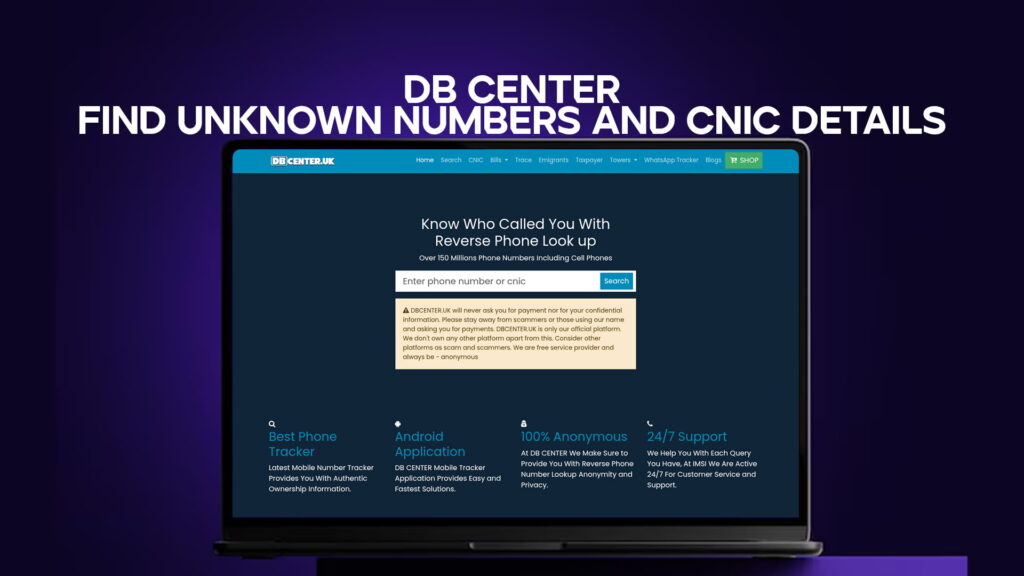
An unknown number calls you. You do not pick up. It calls again. Then again. You do not know if it is someone you should call back, a scammer trying to trick you, or someone you want nothing to do with. Most people in this situation do one of two things. They either ignore it and hope it stops, or they call back without knowing what they are walking into.
There is a better option. DB Center is a reverse phone lookup platform that lets you search any phone number and find out who it belongs to. With a database of over 150 million phone numbers, including mobile and cell numbers, it gives you real information about unknown callers before you decide how to respond. For users in Pakistan, it also connects phone numbers to CNIC registration data, making it one of the most complete identification tools available.
This article explains how the platform works, why finding CNIC details matters, and how you can use DB Center to take back control of who contacts you.
The Problem With Unknown Numbers
Unknown numbers are not just annoying. In many cases, they are genuinely problematic.
Scam calls have become a serious issue across Pakistan and around the world. Fraudsters call from numbers that look legitimate or unfamiliar, pretending to be from banks, government agencies, or utility companies. Their goal is to get personal information, account numbers, or direct payments from unsuspecting people. Once you engage without knowing who is calling, you put yourself at risk.
Harassment through phone calls and messages is another real problem. Victims often have no idea who is behind the number, which makes it difficult to take action or seek help. Without identifying the caller, there is no way to report them properly.
Beyond scams and harassment, there are simpler everyday situations. A missed call from an unknown number could be a job recruiter, a delivery driver, a long-lost contact, or a wrong number. Not knowing which one it is creates unnecessary stress and uncertainty.
DB Center was built specifically to solve this problem. It removes the guesswork by giving you access to information that already exists in SIM registration records, presented clearly and quickly whenever you need it.
What Is a Reverse Phone Lookup?
A reverse phone lookup works in the opposite direction of a regular phone book. Instead of starting with a name to find a number, you start with a number to find the name and other details linked to it.
When you enter a number into DB Center’s search bar, the platform checks it against a database of over 150 million records. These records come from SIM registration data and other publicly linked phone information. The result tells you who the number is registered to, what CNIC it is linked to, which telecom network it belongs to, and sometimes the region where the SIM was activated.
This is especially useful in Pakistan because every SIM must be registered with a valid CNIC under PTA rules. That means almost every active mobile number in the country has a real person’s name and identity attached to it. DB Center makes that connection accessible so that ordinary users can find out who is behind a number without needing official channels or waiting for investigations.
Understanding CNIC Details and Why They Matter
CNIC stands for Computerised National Identity Card. It is issued by NADRA and is the most widely used identity document in Pakistan. Every Pakistani citizen aged 18 and above is required to have one. The card carries a unique 13-digit number that stays with the individual for life.
The CNIC is tied to a person’s full legal name, date of birth, address, and biometric data. Because it is so comprehensive, it is used as the standard verification document for almost everything in Pakistan, from banking and property transactions to SIM card registration.
When someone registers a SIM in Pakistan, they must provide their CNIC and go through biometric verification. This creates a direct link between every mobile number and the identity card of the person it belongs to. If you know the CNIC details tied to a number, you know who owns that SIM.
DB Center surfaces these CNIC details when you search a Pakistani mobile number. The output shows the registered name and identity information, which gives you a clear answer to the question of who called you. This kind of information is what makes the platform far more useful for Pakistani users than generic international lookup tools that have no insight into the local SIM registration system.
Common Reasons to Search an Unknown Number
People search unknown numbers for many different reasons. Most of them are straightforward and completely legitimate.
Repeated calls from an unrecognized number are the most obvious trigger. If a number keeps calling and never leaves a message, knowing who it belongs to helps you decide whether to answer, block, or report it.
Suspicious messages or scam attempts are another common reason. Scammers often use numbers that look like regular mobile numbers. Running a quick check on DB Center can tell you whether the number is tied to a real registered person or shows signs of irregular registration.
Verifying someone before a transaction is a practical use case. If you are buying or selling something online and the other party gives you a contact number, checking that number against their stated name confirms they are who they say they are.
Tracking a number involved in fraud is useful when you have already been targeted or you suspect a family member has been. Identifying the number is the first step before reporting to authorities.
Confirming a business contact is relevant when someone contacts you claiming to work for a company or provide a service. A quick lookup on DB Center can confirm whether the number matches the identity they gave.
Checking contacts on a child’s phone is something parents do to make sure their children are not in contact with people they do not know. This is a safety measure, not an overreach.
Each of these situations involves a genuine need for information. DB Center delivers that information quickly and without complication.
How to Find Unknown Numbers on DB Center
The process is designed to be as simple as possible. Here is exactly how to do it.
Open DB Center in any browser on your phone or computer. The homepage loads quickly and the search function is immediately visible.
Type the number you want to look up into the search field. For Pakistani mobile numbers, include the country code at the start. Pakistani numbers begin with +92, so a number like 0312-9876543 should be entered as +923129876543.
Press the search button. The system processes your request and checks the number against its database of over 150 million records.
Read the results. If the number is in the database, you will see the name of the registered owner, the CNIC details linked to that SIM, the mobile network it belongs to, and other registration information.
If no result appears, the number may not yet be indexed in the current version of the database. The records are updated regularly, so a search run again after a few days may return results. Unregistered or very recently issued SIMs may also return no data.
The entire process takes under a minute. There is no account to create, no subscription to sign up for, and no complicated form to fill in. You enter the number, get the information, and make your decision.
How CNIC Details Help Identify Callers
When a search on DB Center returns CNIC-linked information for a Pakistani mobile number, it gives you more than just a name. It gives you a verified identity.
Because SIM registration in Pakistan is tied to biometric verification through NADRA, the name attached to a CNIC is the legal name of a real person. It is not a username or a display name that someone made up. It is the name on their national identity card, verified at the time of SIM activation.
This means that when DB Center tells you a number is registered to a certain person, that is the actual registered owner of the SIM. You now have something concrete to work with. You can confirm whether the name matches someone you know, whether it matches the identity a caller claimed to have, or whether it raises red flags for further investigation.
This level of detail is what separates DB Center from simpler caller ID apps that only show whether a number has been reported as spam. DB Center goes further by connecting the number to identity registration data, giving you a more complete picture.
What to Do After Identifying an Unknown Number
Finding out who owns a number is the first step. What you do with that information depends on what you found.
If the number turns out to belong to someone you know, or a legitimate business, you can choose to call back or simply ignore it now that you have context.
If the search reveals that the number is linked to a name or identity that seems suspicious, or if the caller claimed to be someone different from the registered name, you should be cautious about any further engagement.
If you believe the number was used for fraud or a scam attempt, report it to your telecom provider. Most networks have a complaint channel for exactly this purpose. You can also report it to the PTA via their official complaint portal.
If the number was used to threaten or harass you, the information you found on DB Center gives you something to bring to the police. A registered name and CNIC details tied to the number makes a report far more actionable than just saying an unknown number contacted you.
If you find that a number appears to be registered under your own CNIC without your knowledge, contact your telecom network immediately to have it blocked, then file a complaint with the PTA.
How DB Center Helps With Identity Protection
Identity theft is a growing problem in Pakistan. One of the most common forms involves someone else’s CNIC being used to register SIM cards without the real owner’s knowledge. These SIMs then get used for fraud, scam calls, or criminal activity. The real CNIC holder only finds out when they receive a complaint, get blocked by a bank, or are contacted by law enforcement.
DB Center helps with this in two ways. First, if you search your own number and find that the registration details do not match your actual identity, that is a sign something is wrong. Second, you can use the platform to check numbers linked to your name to see how they are being used.
Combined with the PTA’s SMS service, where you can text your CNIC to 668 to get a list of registered SIMs, DB Center provides an additional layer of verification that helps you stay on top of how your identity is being used in the telecom system.
Keeping track of this is not something most people think to do until a problem arises. Making it a regular habit, checking annually or whenever something feels off, is a simple way to protect yourself.
Why DB Center Works Better Than Other Options
There are a few alternatives available for looking up phone numbers in Pakistan, but DB Center has clear advantages that make it the stronger choice for most users.
The database is larger. Over 150 million numbers, including mobile and cell phones, means a higher hit rate on any search. Smaller databases miss results regularly and leave users with no useful information.
The data is Pakistan-specific. Generic international lookup tools have no meaningful coverage of Pakistani SIM registration records. They might tell you a number belongs to a Pakistani network, but they cannot tell you who it is registered to or what CNIC it is linked to. DB Center is built with local data that reflects how Pakistani telecom registration actually works.
The interface is accessible to everyone. You do not need technical knowledge or a special account to use it. Anyone who can type a number into a search bar and press a button can get results.
Updates are regular. A lookup database is only as good as how current it is. DB Center updates its records to reflect new registrations and changes, so the results you get reflect the actual current state of SIM registration data as closely as possible.
Tips for Getting the Most From Your Searches
A few simple habits improve the quality of your results.
Always include the country code when searching Pakistani numbers. Entering +923001234567 returns better results than just 03001234567.
Try different formats if a search returns nothing. Some records are stored differently depending on how the number was entered during registration.
Search promptly after receiving a suspicious call. The sooner you check, the sooner you have information to act on.
Use the results as a starting point. If the details you find raise serious concerns about fraud or criminal activity, take the information to official channels rather than trying to handle it alone.
Check your own numbers periodically. Running your own mobile number through DB Center occasionally confirms that your SIM registration details are correct and have not been tampered with.
Final Thoughts
Unknown calls and unverified contacts are problems that show up in everyday life. Most of the time they are minor inconveniences. Sometimes they are genuine threats. Either way, not knowing who is on the other end of a call puts you at a disadvantage.
DB Center changes that. It gives you a fast, reliable way to find unknown numbers and access CNIC details tied to SIM registrations in Pakistan. With a database of over 150 million numbers and a system built around how Pakistani telecom registration actually works, it covers the ground that matters most for users in the country.
Whether you are checking a suspicious caller, verifying a new contact, protecting yourself from fraud, or simply satisfying your curiosity about a missed call, DB Center delivers the information you need without making you jump through hoops to get it. It is a practical tool for a practical problem, and it is available any time you need it.
DB Center can identify numbers that are in its database of over 150 million records. For Pakistani mobile numbers tied to SIM registration data, it returns the registered name and CNIC details. Numbers not yet indexed may not return results, but the database is updated regularly.
When you search a Pakistani mobile number, DB Center returns the name of the person the SIM is registered to along with CNIC-linked information from the SIM registration record. This helps you verify the identity of whoever owns that number.
Looking up a number for personal safety, identity verification, or fraud protection is a legitimate use. The data comes from SIM registration records tied to publicly submitted identity information. Using the platform to stalk or harass someone is not a legitimate use and may be illegal under Pakistani cybercrime laws.
Contact your mobile network provider immediately and request that the SIM be deactivated. Then file a complaint with the PTA through their official complaint portal. If the number has been used for fraud, consider filing a police report as well.
Yes. DB Center covers numbers across all major Pakistani mobile networks including Jazz, Telenor, Zong, Ufone, and SCO. The search returns results based on SIM registration data regardless of which network the number belongs to.